DISTRIBUTION STATEMENT A. Approved for public release. Distribution is unlimited.
My work lies at the intersection of materials science and optical physics, seeking to answer fundamental questions and establish foundational knowledge of how light and matter interact with one another. This work is typically communicated through articles published in peer reviewed scientific journals, although those venues can have limited impact on broader audiences. In this section I hope to communicate what we are doing, and why we are doing it, in a manner more digestable to the casual reader. More to come!
Midinfrared Nanophotonics
Ultralow-loss polaritons in isotopically pure boron nitride
Nature Materials (2018)
Abstract
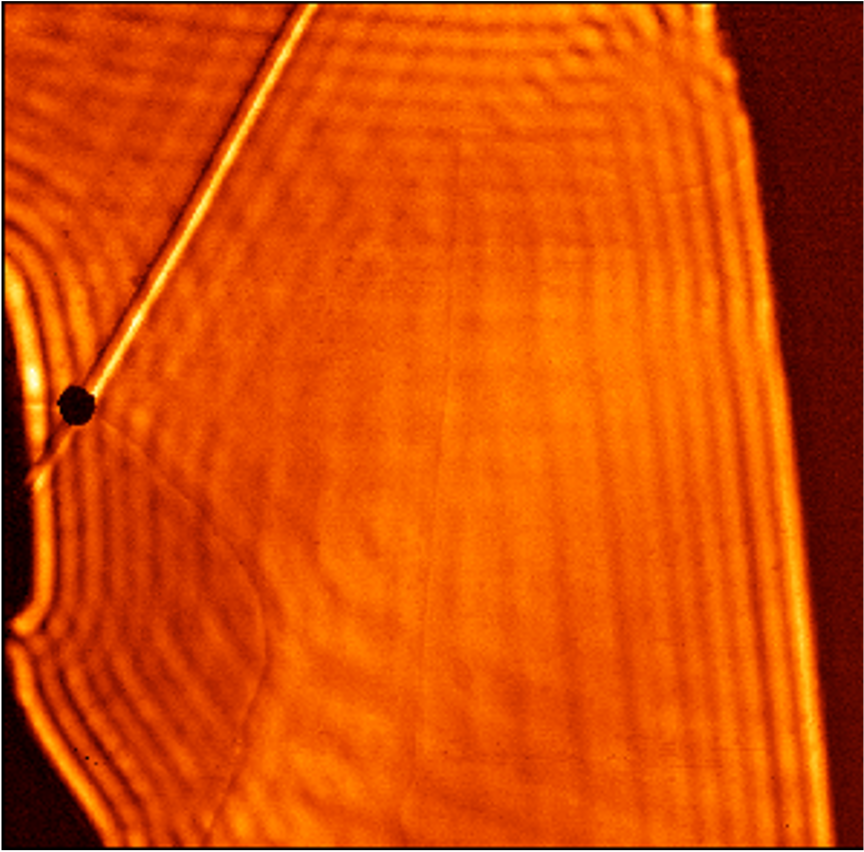 Conventional optical components are limited to size scales much larger than the wavelength of light, as changes to the amplitude, phase and polarization of the electromagnetic fields are accrued gradually along an optical path. However, advances in nanophotonics have produced ultrathin, so-called ‘flat’ optical components that beget abrupt changes in these properties over distances significantly shorter than the free-space wavelength. Although high optical losses still plague many approaches, phonon polariton (PhP) materials have demonstrated long lifetimes for sub-diffractional modes in comparison to plasmon-polariton-based nanophotonics. We experimentally observe a threefold improvement in polariton lifetime through isotopic enrichment of hexagonal boron nitride (hBN). Commensurate increases in the polariton propagation length are demonstrated via direct imaging of polaritonic standing waves by means of infrared nano-optics. Our results provide the foundation for a materials-growth-directed approach aimed at realizing the loss control necessary for the development of PhP-based nanophotonic devices.
Active tuning of surface phonon polariton resonances via carrier photoinjection
Nature Photonics (2018)
Abstract
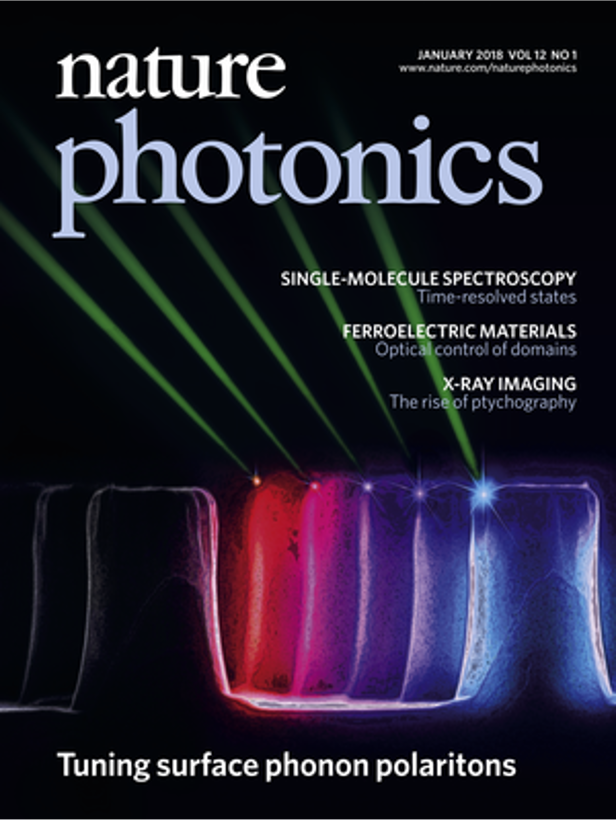 Surface phonon polaritons (SPhPs) are attractive alternatives to infrared plasmonics for subdiffractional confinement of infrared light. Localized SPhP resonances in semiconductor nanoresonators are narrow, but that linewidth and the limited extent of the Reststrahlen band limit spectral coverage. To address this limitation, we report active tuning of SPhP resonances in InP and 4H-SiC by photoinjecting free carriers into nanoresonators, taking advantage of the coupling between the carrier plasma and optic phonons to blueshift SPhP resonances. We demonstrate state-of-the-art tuning figures of merit upon continuous-wave excitation (in InP) or pulsed excitation (in 4H-SiC). Lifetime effects cause the tuning to saturate in InP, and carrier redistribution leads to rapid (<50 ps) recovery of the resonance in 4H-SiC. This work demonstrates the potential for this method and opens a path towards actively tuned nanophotonic devices, such as modulators and beacons, in the infrared, and identifies important implications of coupling between electronic and phononic excitations.